
So How Does It Work
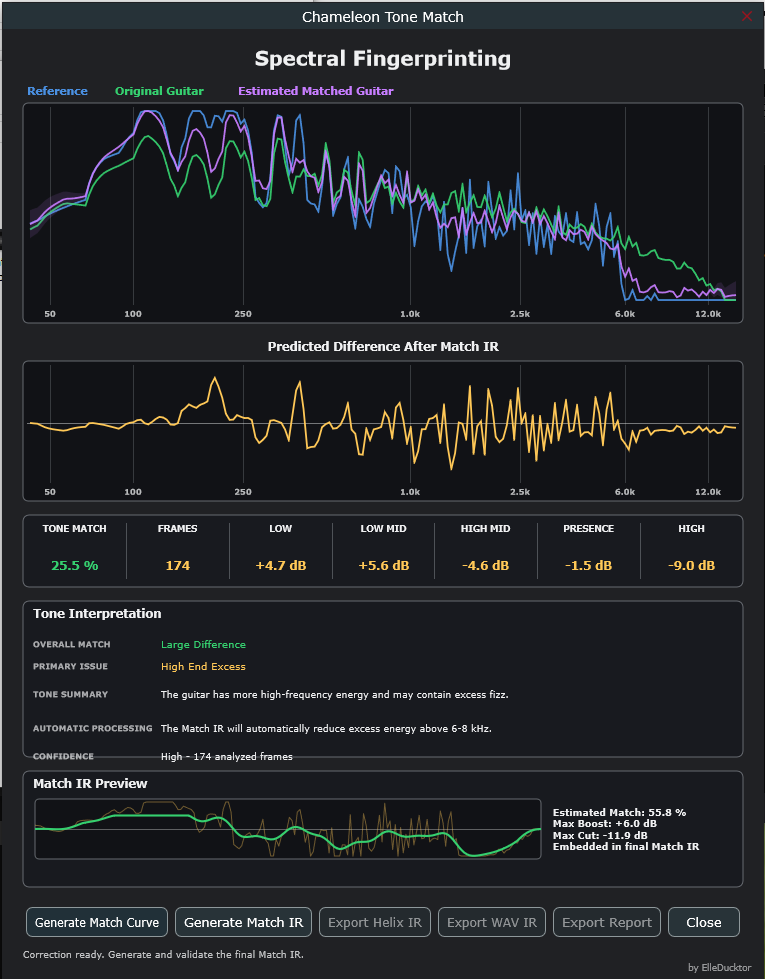
Chameleon Tone Match performs event-based spectral matching by first identifying and aligning corresponding musical events between the reference and captured performances. Matched events are transformed into the frequency domain using FFT analysis to generate spectral fingerprints. The plugin computes the differential frequency response between the matched spectra, applies smoothing and stability constraints, then synthesizes a minimum-phase FIR correction filter. The resulting impulse response is internally verified against the reference before being exported as a Match IR.
The DSP pipeline performs time alignment, onset detection, event pairing, and spectral fingerprint extraction using FFT-based analysis. Spectral differentials are accumulated across matched musical events to estimate a target transfer function while rejecting unrelated material. The estimated transfer function is constrained for stability, converted to a minimum-phase response, synthesized as a finite impulse response (FIR) filter, and validated through closed-loop spectral verification prior to export.
Breaking it down into DSP stages
- Time Alignment – Synchronizes the reference and performance.
- Onset Detection – Detects note/chord attack events.
- Event Matching – Pairs corresponding musical events while rejecting mismatches.
- Spectral Analysis – Computes FFT-based spectral fingerprints for each matched event.
- Transfer Function Estimation – Calculates the frequency-response difference between the reference and capture.
- Response Conditioning – Applies smoothing, weighting, and boost/cut constraints to produce a stable correction curve.
- Minimum-Phase Conversion – Converts the target response into a causal minimum-phase filter.
- FIR Synthesis – Generates the finite impulse response (Match IR).
- Closed-Loop Verification – Applies the generated IR internally and measures the residual spectral error to quantify match accuracy.
In simple terms:
- Time domain: Shows how the audio waveform changes over time.
- Frequency domain: Shows how much energy exists at each frequency (bass, mids, highs, harmonics, etc.).
Chameleon Tone Match complements your existing presets by generating a precision Match IR that adapts your current tone toward the reference recording.

For Chameleon Tone Match, the FFT allows the software to analyze the tonal content of each matched note or chord. Rather than comparing raw waveforms, it compares their frequency spectra to determine how the captured tone differs from the reference. Those spectral differences are then used to calculate the corrective frequency response that becomes the Match IR.
For example, if the FFT shows:
- The reference has more energy around 2.5 kHz than your recording, the correction may boost that region.
- Your recording has excessive energy around 250 Hz, the correction may reduce that region.
The FFT doesn’t create the IR by itself—it provides the frequency-domain information that the DSP uses to estimate the corrective transfer function, which is then converted into a minimum-phase FIR impulse response. The cleaner and tighter you play the better the IR. How ever the algorithm allows for beginners all the way to advanced players including a grading system. Lets face it. Every one can improve our skills. But do not focus on the grade. The algorithm itself accounts for many different things. I am an advance player and the highest score I have gotten is a 72%
So, in 2 sentences:
FFT (Fast Fourier Transform) is the algorithm that converts audio into its frequency spectrum so Chameleon Tone Match can compare the tonal content of matching musical events.
Chameleon Tone Match matches corresponding musical notes, compares their frequency spectra, computes the tonal differences, and converts those differences into a corrective EQ impulse response that reproduces the reference tone.
Chameleon Tone Match created by ElleDucktor
Chameleon Tone Match V1.0 © 2026 PiMedia. All Rights Reserved